
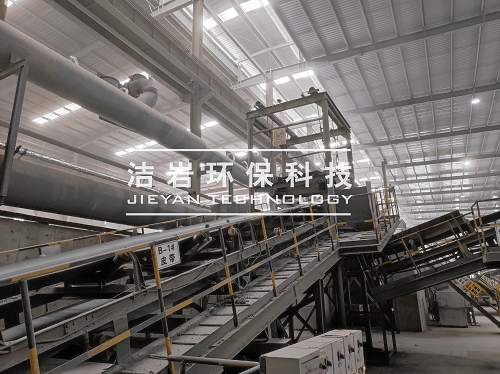

Recently, the "Dust Control Project for the Steel Slag Treatment, Transfer, Rod Milling, and Magnetic Separation Processes" at Changzhou Oriental Special Steel Co., Ltd. is now in its final stages.
Changzhou Oriental Special Steel Co., Ltd. operates two steel slag processing lines. On each line, the steel slag is transported via conveyor belts to a jaw crusher for pulverization. It then sequentially passes through a vibrating screen, a rod mill, and a trommel screen. Finally, a magnetic separator is used to separate the converter waste slag blocks from the slag steel and slag iron. The converter tailings are also transported by conveyor belts to two converter tailings bins located in the northeastern area of the steel slag processing workshop. Additionally, water-quenched blast furnace slag is stockpiled in the southwestern area of the steel slag processing workshop.
During the steel slag processing phase, the handling of slag generates significant amounts of steam and dust at multiple points. This occurs when trucks dump steel slag or water-quenched slag into the processing workshop, when loaders feed the slag into the charging hopper, and throughout subsequent processes such as transfer, crushing, screening, rod milling, and magnetic separation. Particularly when trucks unload slag into the workshop and when loaders feed it into the hopper, water vapor volatilizes explosively, stirring up large clouds of smoke and dust. This results in the entire steel slag processing workshop being filled with steam and dust, severely impacting the plant environment and the health of personnel.
Shanghai Jieyan Environmental Technology Co., Ltd. conducted on-site surveys and designed solutions for the production line. Dust collection points were added to key areas, including the steel slag storage zone, water-quenched slag storage zone, two steel slag feeding hoppers, 20 conveyor belts, two jaw crushers, two vibrating screens, two rod mills, two trommel screens, and one magnetic separator. These measures were implemented to meet the requirements for ultra-low emissions and clean production.
Work overtime while ensuring quality and quantity, completing the project installation to high standards.
The newly constructed wet dust collection system and dry mist dust suppression system will target specific areas within the steel slag processing workshop, including the steel slag storage zone, water-quenched slag storage zone, and the two steel slag magnetic separation process lines. The specific collection points are: 2 steel slag feeding hoppers, 2 crushers, 2 vibrating screens, 2 rod mills, 2 trommel screens, 1 magnetic separator, 18 conveyor belts, and the steel slag and water-quenched slag storage areas. Based on the steel slag processing workflow and the on-site dust emission conditions, these points are divided and designed into 2 sets of wet dust collection systems and 1 set of dry mist dust suppression system.
◈ One wet dust collection system is responsible for capturing and treating the dust and water vapor generated during the operation of both Production Line A and Production Line B. The control system allows for selective activation of dust collection for either Line A or Line B.
◈ One wet dust collection system is responsible for capturing and treating the dust and water vapor generated in the storage area, as well as providing ventilation for the entire storage area.
◈ One dry mist dust suppression system is responsible for dust control at the final magnetic separation discharge points and some transfer stations of both Line A and Line B.